Illinois roofing contractor #104-001-614
Roofing and Siding
A roof fails at the details, not in the middle of the field. Get the valleys, the flashing and the eave right and the shingles do their job for decades.
Chapter 01
A roof rarely fails in the middle
Shingles in the open field of a roof, the flat run between the ridge and the eave, are the part that looks like it does all the work and almost never is where a leak starts. The real failure points are the details: the valley where two roof planes meet and funnel every drop of water off both sides into one channel, the step flashing woven in where a roof meets a sidewall, and the rubber boot around a plumbing vent pipe that dries out and cracks years before the shingles around it show any wear at all.
White Heath gets the other failure point every winter: ice damming. Snow melts off the warmer part of the roof over the living space, runs down to the cold overhang past the exterior wall, and refreezes there into a ridge of ice that backs water up under the shingles instead of letting it drain off the edge. A roof that has gone through one thaw and freeze cycle without ice and water shield at the eave is a roof that has been lucky, not a roof that was built right.
C.B.E. Construction has been repairing and replacing roofs around White Heath since 1998, and the calls that come in years after a bad roof job are almost always one of those four spots: a valley, a piece of step flashing, a pipe boot, or an eave with no ice barrier under it.
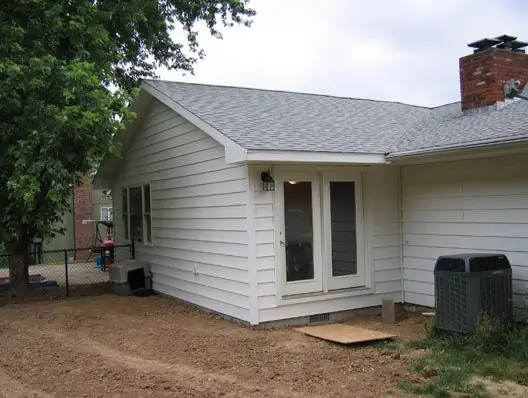
Home addition in White Heath with new siding and a roofline tied into the existing house, finished with French doors
Tear off, or go over the top
The decision that gets made the day the old roof comes off, or does not come off, is whether to strip it to the decking or lay a new layer of shingles over the old one. Going over the top is faster and cheaper, and Illinois building code allows it up to a point, but it only works if the decking underneath is actually sound and there is not already more than one layer up there.
The problem with a second layer is that it hides exactly what it is supposed to reveal. Rotted decking, a soft spot where water has been getting in for years, or a valley that was flashed wrong the first time, all get covered up instead of fixed. A tear off is the only way to see the deck, replace what needs replacing, and start the new roof on something solid. C.B.E. checks the decking before quoting either option, not after the old shingles are already off and the surprise is unavoidable.
Chapter 03
Storm damage, and the first hour after
After a hailstorm or a wind event tears shingles loose, what happens in the first hour matters almost as much as the repair itself. Photograph the damage from the ground before touching anything: the missing or lifted shingles, any granules collecting in the gutters or downspouts, and anything on the ground that came off the roof. If a section is exposed to the sky, get a tarp over it to stop water from getting into the attic while the repair is scheduled, secondary water damage inside the house costs far more than the roof repair that would have prevented it.
An insurer wants dated photos, a written description of what happened and when, and a real repair estimate, not a verbal guess. C.B.E. Construction handles storm damage repair calls around White Heath and the Champaign-Urbana area and can put together documentation that holds up with an adjuster, not just a patch on the roof.
Siding only works on a straight wall
Siding is not just a finish nailed to the outside of a house. Underneath it there is house wrap that has to lap correctly, shingle-style, so water runs down and off rather than behind the siding, and flashing over every window and door opening so the same water sheds outward instead of collecting at the top of the trim. Get the wrap and the flashing wrong and the siding will look fine for a couple of years before the sheathing behind it starts to fail.
Vinyl, wood, and metal siding do not fasten the same way, and treating them as interchangeable is where a lot of siding jobs go wrong. Vinyl has to be nailed with room to expand and contract with temperature, not pulled tight to the wall. Wood is either face nailed or hung on hidden fasteners depending on the profile. Metal panels need their own screw pattern and clearance for the same expansion vinyl needs, just handled differently because the material moves differently. C.B.E. installs and repairs all three around White Heath, and the crew fastens each one the way it is actually supposed to go up.
C.B.E. Construction is an Illinois licensed roofing contractor (#104-001-614), lead-safe EPA certified, and GAF certified for roofing installations. Call (217) 762-5432 for a free estimate on roofing or siding in White Heath.
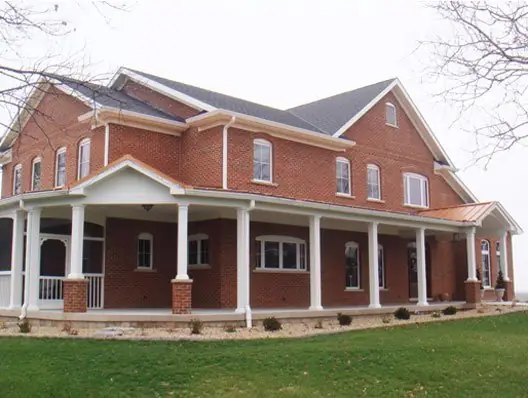
One house, more than one material
Metal above the porch, shingles above the house
It is normal for a home to carry more than one roofing material at once, a standing seam metal roof over a porch tied into an asphalt shingle roof over the main house, as long as the flashing between the two is done correctly where they meet. Get that transition wrong and it becomes the next leak on the list.
C.B.E. Construction builds and re-roofs porches, additions and whole houses together, so the roofline actually ties in rather than looking bolted on. See more finished exteriors, or read about how an addition marries into a house that is already standing.